Microphone Calibration
Microphone frequency response calibration is performed in several steps by acoustically comparing the measurement to a reference microphone. 1. Frequency response in the range 10 Hz to 500 Hz. Here, the measurement/calibration is performed in accordance with DIN EN 61094-5. In a small pressure chamber. The test signal is applied to the test sample and the reference microphone simultaneously. (Note: For low frequencies below approximately 2 kHz, the frequency response can be easily determined in a pressure chamber, regardless of whether the microphone is free-field, diffuse-field, or pressure-field equalized. See also B&K literature.)
2. Frequency response in the range 500 Hz to 20 kHz Here, the measurement/calibration is carried out using the substitution method based on DIN EN 61094-8 and a time-selective procedure (Chapter 6.2.3). First, a reference sound source is measured at a defined measurement location using a reference microphone. The reference microphone is then replaced by the test object, and the measurement is repeated.
3. The frequency response of the test object is composed of the individual frequency responses determined in steps 1 and 2.
4. Measurement of the microphone's open ircuit output voltage. The microphone is subjected to an acoustic calibration signal (1 kHz / 94 dBspl). The microphone output signal is measured as a differential voltage measurement at thenon-inverting and inverting microphone outputs. The microphone is powered with 48 V phantom power in accordance with DIN EN 61938 Table 11.
5. The frequency response is assessed based on
DIN EN 61672 -1 "Sound Level Meters, Part 1: Requirements for Sound Level Meters.".
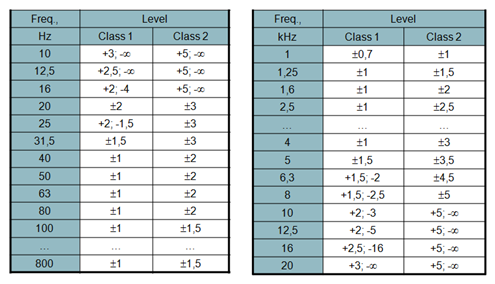
The assessment is not carried out according to DIN EN 61094-4 since this standard only serves to assess the frequency response of the microphone capsule.